
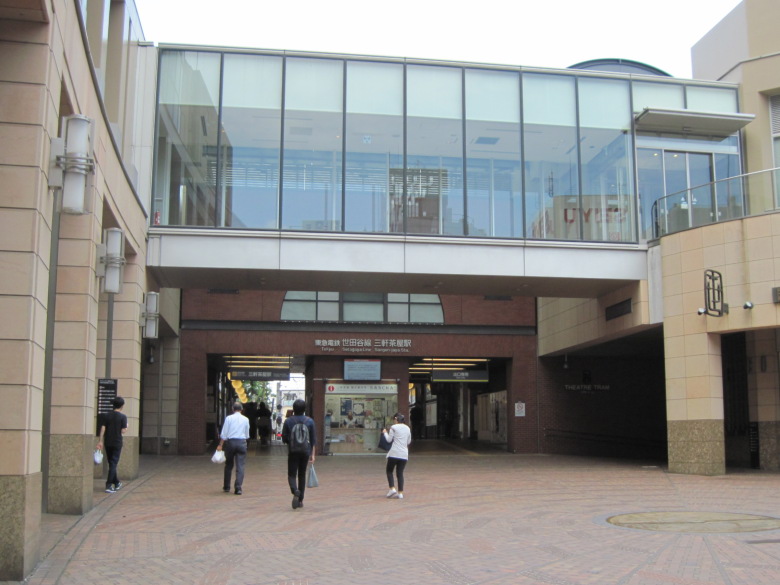
Sangenjaya Station
I took the Setagaya Line to the vicinity of Kokushikan University to continue walking along the Karasuyama River Greenway, which is upstream of the Meguro River.
I took the Setagaya Line from Shimotakaido Station about a month ago, so this time I decided to take it from Sangenjaya Station. Sangenjaya station is a bit of a distance from the Denentoshi line to the Setagaya line, but it’s a nice station, including its passageway.
The tourist information center in the photo had just opened on March 31 of this year, less than two months ago. I should have asked them to show me something.
On the Setagaya Line, the moment you touch down at the Sangenjaya station, the fare is deducted in advance, so all you have to do is get on and get off. This time, the in-train announcement was very polite, so I didn’t get lost at all.

Shoin-jinja Station
Get off at Shoin-jinja Station.

Shoin Shrine
About 250 meters to the north is the Shoin Shrine. It is well cleaned and dignified.

Karasuyama River Greenway
I passed to the right of the shrine, and after another 200 meters, I entered the Karasuyama River Greenway.

loquat
As soon as I entered the greenway, I found a loquat! This was the first time I saw them on a branch.
From the song, I thought they ripened two at a time, but I guess they ripen in large groups. I wonder what part of the leaves with a light rainbow are you referring to?

Kokushikan Junior and Senior High School
This is Kokushikan Junior and Senior High School. All the buildings look new, like a school for rich people. The rooftop of the building in the back may be a playground.

Hollyhock
In my article on the Karasuyama River Greenway two weeks ago, I introduced many flowers. This time, too, many flowers were in bloom, and I would like to introduce them to you. First of all, I found holly hock.

Thanks to Dazai literature, we have the impression that evening primrose is a yellow flower. However, the yellow flower is botanically known as the oenothera stricta. The true evening primrose (oenothera tetraptera) is a white flower similar to this one.

Oxalis
Oxalis is a beautiful flower. But since it is a member of the oxalidaceae, I think it is very fertile.

Salvia pearl white
Salvia pearl white is also known as cherry sage.
It is said to smell like cherries, so I will try to smell it next time I see it.

Deutzia
Another name for deutzia is “unohana” (meaning “flower of the rabbit”). It is said to bloom in the month of Ugetsu (April in the lunar calendar).
A dish made from the dregs of pressed soybeans is also called “Unohana”, but is it similar?

Coreopsis lanceolata
Coreopsis lanceolata is a specific invasive species. It is listed at the top of the list of plants on the Ministry of the Environment’s page on specific invasive species. It is said that it is necessary to mow it down during the rainy season to prevent it from fruiting because of its tough nature and it can degrade the native species.

The road to Umegaoka Station
This is the path I took to Umegaoka Station two weeks ago. So I will continue walking from here.

Karasuyama River Greenway blocked by Setagaya Line
After about 1.2 km, the Karasuyama River Greenway was blocked by the Setagaya Line. This is near Miyanosaka Station.
One station north of Miyanosaka Station is Yamashita Station, where the Setagaya Line is also blocking the Kitazawa River Greenway. Is it possible to save construction costs by building a station on the river?
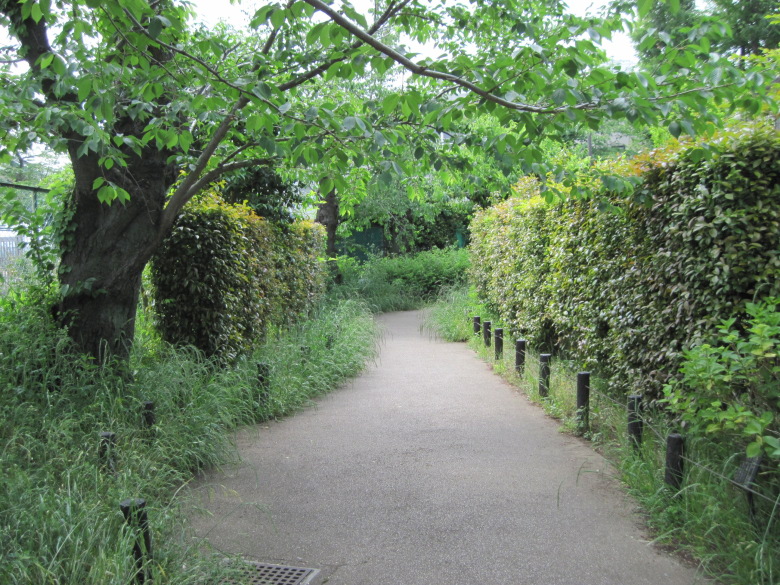
The Path of Manyo
As I approached the Manyo Trail, the path became narrow and dense. I wondered if the path was still intact.
But when I stepped into the path, I found that it was carefully maintained, and trees with name tags appeared one after another. It seems that they are collecting useful trees for the Manyo Trail.

Chonowski’s hornbeam
This is a Chonowski’s hornbeam. It is a useful tree that can be used for construction, tools, charcoal and firewood.

Styrax japonica
This is Styrax japonica. The oil from the berries was used to make kerosene and soap.

Taxus tree
Taxus tree. It is said to be the first because it was used to make the scepter.

A mysterious silver structure on the roof
Just past the Odakyu line, I spotted a strange silver structure on the roof of a building on my right.
Since it was on the rooftop, I guessed it was a device to use sunlight. But it doesn’t look like a solar power generator, nor does it look like a device for obtaining hot water. What is its purpose?

Chitosedai intersection
At the Chitosedai intersection, I cross Loop Route 8.
The greenery in front of me on the left is the trees of the Roka Koshunen Garden, where I am heading.

Roka Koshunen Garden
Roka Koshunen is a huge and serene park. It is more than 1km away from the nearest stations, Roka-Koen and Hachimanyama, so it is a little difficult to get there by train and on foot.
Volunteers were taking care of the flower beds.

Kaleidoscope
The name of this plant is Kaleidoscope. The way the leaves are attached and spotted does not look like that.

Setagaya observation well
The observation wells are monitoring land subsidence.
On a nearby signboard, there is a theory that if too much groundwater is pumped up, the groundwater level will drop and the change in the water level will indicate land subsidence. But I wondered if that theory was true. Isn’t it like measuring the height of the sea surface from the top of a ship? It doesn’t matter if it’s high tide or low tide, the height doesn’t change, right?

The road beside Setagaya Automobile School
Beside the Setagaya Automobile School, there is a break in the greenway. But there must be a culvert underneath it.

Trailing ice plant
It is now a greenway again. New plants and flowers appear. This is a trailing ice plant.
It looked so gorgeous. If I see it at a home improvement store, I might try to plant it in my garden.

Ligustrum japonicum
I think this is a Nezumimochi (Ligustrum japonicum). I’ve heard that its leaves look like those of the Mochinoki (Ilex integra), but they look different because they are young leaves. I’m sorry if I’m wrong.

Gazania
Gazania is also called Kunshougiku (medallion chrysanthemum). There are many variations.
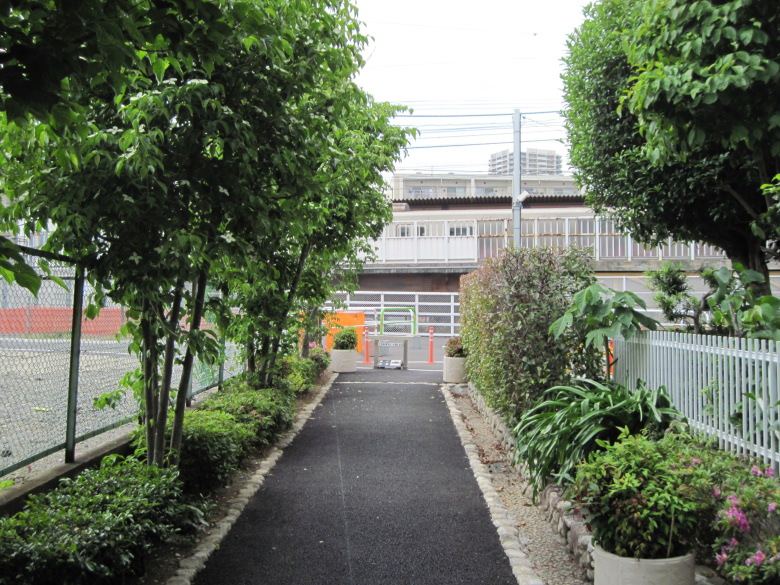
Keio Line
The Keio Line is now in sight. The greenway has become much thinner, but it continues under the railroad tracks.

Chitose Karasuyama Station
I went northeast along the Keio Line for about 100 meters to Chitose Karasuyama Station.
The word “Karasuyama-gawa Ryokudo” comes from the name of a place in this area.
Walking data
Course: Kokushikan University -> Karasuyama River Greenway -> Chitose Karasuyama
Distance: 7.8km
Time: 1h50m

