
Have you ever heard of an observation field? It is a place to observe temperature, humidity, atmospheric pressure, precipitation, rainfall, and snow depth.
I happened to stumble upon it while taking a walk around the Imperial Palace.
。
There is a mailbox in the Imperial Palace
I’ve walked the southern half of the Imperial Palace along the old Koshu Kaido. Today, I decided to walk the northern half.

Ceiling at Marunouchi North Exit of Tokyo Station
As I exited the ticket gate at the Marunouchi North Exit of Tokyo Station, I saw a beautiful ceiling, so I posed as a country visitor and took a picture. In fact, I am a country visitor…

Tokyo Station
I went straight outside and took a picture of the station building. There are many tourists here.

Kikyo-mon Gate
Facing the Imperial Palace with your back to Tokyo Station, pass through the Wadakamon gate and hit the inner moat, and there you will find the Kikyo-mon gate. It is a picturesque gate.
However, the stone wall at the gate is piled with molded stones without any gaps, while the stone wall at the far end has gaps that look like they could be climbed by ninjas. I wonder if the reason why they didn’t pile the stones without gaps was for cost reasons.
We returned to Uchibori Street and continued along the moat.

Willow tree
This area is northeast of the Imperial Palace. It is the unlucky direction, so willow trees are planted here.

Otemon Gate
The Otemon Gate was open and I could enter the Imperial Palace from here.
I decided to stop my plan to walk along the north side of the palace and take a tour inside the palace.
I lined up in the queue to check the contents of my bag.

Admission ticket
There is no charge, but you will be given an admission ticket. The front is in Japanese and the back is in English.

Mailboxes in the Imperial Palace
As soon as I entered, there was a mailbox. I wondered what kind of postmark it would have. Next time I come here, I will bring my mail with me.

Hyakunin Guardhouse
There is a building for the Hyakunin guardhouse. Four groups of gunmen, the Kouga group, the Iga group, the Negoro group, and the 25 horsemen group, worked there.
I was deeply moved by the atmosphere, as if the yoriki and doshin with their topknot were about to come out.

Kikuyo Cultural Association Honmaru Shop
This is the Kikuyo Cultural Association Honmaru Shop, where souvenirs are sold.
Souvenirs with the chrysanthemum crest on them were on sale.

Remains of the Grand Mistress
What do you think this place used to be?
The remains of the Grand Mistress!
I closed my eyes and let my mind drift back to the glamorous scenes of ancient times.

The foundation of a Castle tower
I thought it was a Japanese pyramid, but it was the foundation of a Castle tower However, since the shogunate deemed it unnecessary, no keep was built on this tower, which was constructed in 1659. Was it because the rebellion had died out by then? Or was it because it was deemed too costly?

Tokagakudo
Tokagakudo is a music hall built in commemoration of Empress Kojun’s 60th birthday.

The North Kitahanebashi Gate
After returning the admission ticket, I left the Imperial Palace through the North Kitahanebashi Gate. I forgot to see the ruins of the Great Pine Hallway.
Discovering an observation field in Kitanomaru Park
I looked for a nearby station and found Kudanshita Station, so I decided to go back through Kitanomaru Park.

Science Museum
The Science Museum is a hard place to come by, and it was the science museum I longed for the most when I was little. I’ve only been in there twice so far. One of those times was for a fuel cell experiment, more than 20 years ago. At the time, I was wondering if it would ever be practical, since oxygen and hydrogen are consumed in a blink of an eye, but I was surprised to find out that it is now used to make cars.

Observation field
I could see the sidewalk in the park to the west, so I decided to walk on the sidewalk. Then, I found an observation field!
At first, I thought it was just an off-limits area, but as I got closer, I saw a row of measuring instruments for weather observation.

Rain sensor
The rain sensor has electrodes attached to the uppermost conical surface, and detects rain by short-circuiting between the electrodes with raindrops.

Tumble rain gauge
The tumbling rain gauge has a mechanism like “Shishi Odoshi” inside, and the number of times the mechanism falls over is used to measure the amount of rainfall.
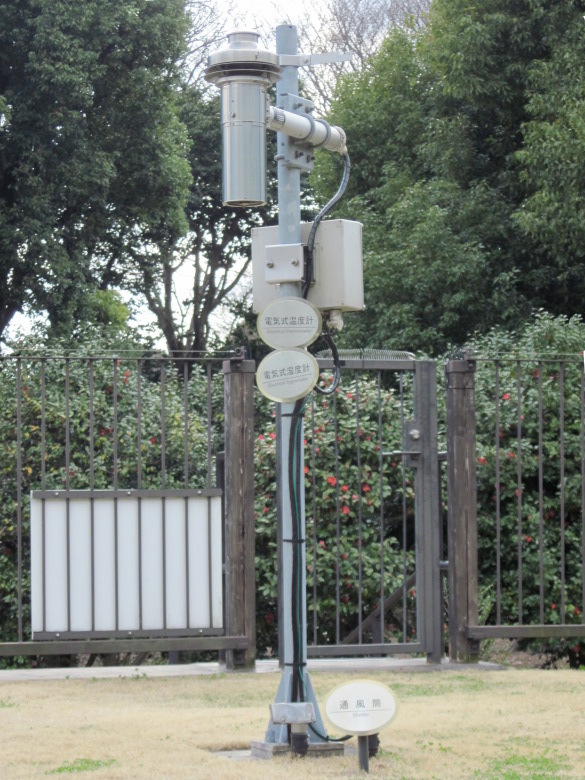
Electric thermometers and electric hygrometers
Electric thermometers measure temperature by measuring the resistance value of a resistance thermometer, an element whose resistance value changes with temperature. Electric hygrometers measure humidity by measuring the capacitance of a capacitor whose capacitance value changes with humidity, or the resistance of an element whose resistance value changes with humidity.

Snow gauge (laser type)
A snow gauge (laser type) fires a laser beam at the snow surface and measures the amount of snow cover by the time it takes for the beam to return.

Tayasumon Gate
I came out of Kitanomaru Park through the Tayasumon Gate. This photo was taken looking back towards the Tayasumon Gate.
I think what looks like a waterfall is the channel where the water from Chidorigafuchi flows into Ushigafuchi. It’s such a big drop.
Walking data
Course: JR Tokaido Line Tokyo Station -> Imperial Palace -> Kitanomaru Park → Tokyo Metro Tozai Line Kudanshita Station
Distance: 4.1km
Time: 1h16m

コメント